


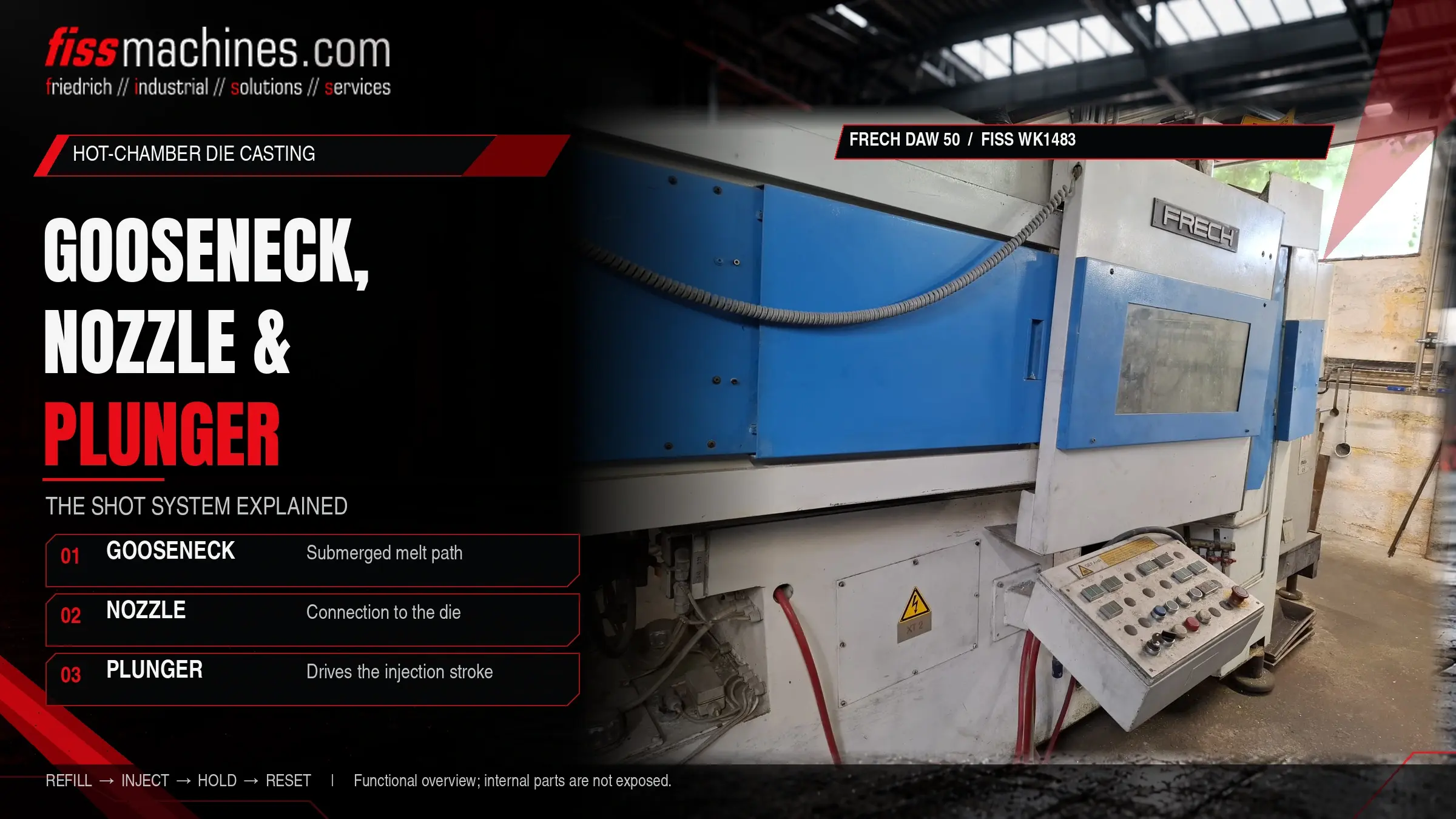
Gooseneck, Nozzle and Plunger: The Shot System of a Hot-Chamber Die Casting Machine
Every shot on a hot-chamber die casting machine depends on three components that sit directly in or next to the molten metal: the gooseneck, the plunger and the nozzle. Together they form the shot system that replaces ladling in zinc and magnesium die casting. Their condition decides whether shot speed, part weight and cycle time remain stable – and they are among the first things to check on a used machine.
What Do Gooseneck, Plunger and Nozzle Do?
The gooseneck is a cast metal body immersed in the melt. It contains the shot cylinder and a curved channel leading up to the die. The plunger moves inside the cylinder: when it retracts, melt flows in through a fill port; when it moves down, it pushes the metal through the channel. The nozzle connects the gooseneck to the sprue bushing of the die and must be kept hot so that the metal does not freeze in it.
Erosion by the melt, sliding wear between plunger and cylinder and thermal load at the nozzle are the main wear mechanisms. Typical consequences are slower fills, fluctuating part weights and metal leaking at the nozzle.
How the Hot-Chamber Shot System Works
In a hot-chamber machine, the shot system is part of the furnace. The gooseneck stands in the metal bath of the holding pot, so the shot cylinder is always filled with liquid metal at the right temperature. A separate metal transfer to the machine, as in cold-chamber die casting, is not required.
Filling
With the plunger retracted, the fill port in the cylinder wall is open and melt flows from the bath into the shot cylinder.
Injection
The plunger moves down, closes the fill port and pushes the metal through the gooseneck channel and the nozzle into the closed die. The shot is typically run in several speed phases.
Intensification and Solidification
The plunger holds pressure while the casting solidifies in the die.
Return
The plunger returns to its start position. Metal that has not solidified flows back through the nozzle and gooseneck, and the cylinder refills for the next shot.
Because filling happens automatically with every plunger return, hot-chamber machines achieve short cycle times. A basic comparison of both machine types is given in the article Cold Chamber or Hot Chamber?.
The Three Parts of the Shot System
Melt Container and Channel
Made of iron-based material. It houses the shot cylinder and the riser channel to the nozzle. Some designs use a replaceable sleeve or liner in the cylinder bore, so the body can be refurbished instead of replaced.
Shot Piston with Rings
Driven by the hydraulic shot cylinder above the bath. Piston rings seal against the cylinder wall. As rings and bore wear, more metal bypasses the plunger and less of the stroke reaches the die.
Heated Connection to the Die
Seats against the sprue bushing of the fixed die half. Depending on the design, it is heated by gas burners or electric heaters, because the metal in it must not freeze between shots.
The parts are matched to each other and to the machine: plunger diameter, cylinder bore, gooseneck geometry and nozzle length determine the available shot volume and the pressure on the metal. Changing one of them changes the process.
Where the Shot System Wears – and How It Shows
The shot system works permanently at melt temperature. Three mechanisms dominate: erosion and chemical attack of the bore and channel by the melt, sliding wear between plunger rings and cylinder, and thermal load at the nozzle, which is heated from outside and cooled at its contact with the die.
| Symptom | Possible Cause | What to Check |
|---|---|---|
| Fill time increases, shot speed drops | Worn plunger rings or cylinder bore, metal bypassing the plunger | Shot curve, ring condition, bore diameter |
| Part weight fluctuates | Leakage at the plunger, changing bath level | Ring condition, bath level control, ingot feeding |
| Metal leaks at the nozzle tip | Damaged seat at nozzle or sprue bushing, insufficient nozzle contact | Nozzle tip, sprue bushing, nozzle alignment |
| Metal freezes in the nozzle | Nozzle heating too low or failing | Burner or heater, temperature sensor, settings |
| Cold shuts or porosity increasing | Melt or nozzle temperature too low, unstable shot | Temperatures, shot profile, die temperature |
Zinc, Magnesium – and Why Aluminium Is Different
Zinc es el material clásico de cámara caliente. Las aleaciones de zinc para fundición en caliente se funden a bajas temperaturas; la ficha técnica de Zamak 3 de Nyrstar indica un rango de fusión de 381–387 °C, lo que mantiene la carga térmica sobre el sistema de disparo de forma moderada.
Magnesium también puede fundirse en máquinas de cámara caliente, pero a temperaturas claramente más altas y con sus propias exigencias de protección de fusión y seguridad. Por ello, las máquinas de magnesio se diseñan para este propósito; el inventario de FISS, por ejemplo, incluye máquinas de cámara caliente dedicadas Frech DAM para magnesium junto a máquinas Frech DAW para zinc.
Aluminium ataca fuertemente a los materiales basados en hierro a su temperatura de fundición. Las aleaciones estándar de aluminio se funden, por tanto, en máquinas de cámara fría; los procesos de cámara caliente para aluminio existen solo como soluciones especializadas para piezas pequeñas. Más sobre las aleaciones en Aluminio, Zinc o Magnesio?
Mantener estable el Sistema de Disparo
Los intervalos para cambios de anillos, inspección del cuello de ganso y reemplazo de la boquilla dependen de la aleación, la velocidad de ciclo y el diseño de la máquina, por lo que la documentación del fabricante es la referencia. En la práctica diaria, los siguientes puntos han probado ser útiles:
- Monitorear la temperatura de la boquilla y la función de calentamiento de forma continua, no solo tras una avería
- Inspeccionar la punta de la boquilla y el asiento del casquillo del sprue en cada cambio de troquel
- Registrar los cambios de anillos del émbolo junto con las lecturas del contador de disparos
- Mantener el nivel del baño constante: la alimentación automática de lingotes ayuda
- Quitar la escoria regularmente: el metal contaminado acorta la vida del cilindro, la funda y el émbolo
- Mantener un juego de repuesto emparejado (cuello de ganso, émbolo, boquilla) para reducir el tiempo de inactividad
- Precaliar las piezas de repuesto según el fabricante antes de instalarlas en el baño
El equipamiento periférico, como alimentadores de lingotes, unidades de extracción y sistemas de pulverización, se enumera bajo automatización para fundición en cámara caliente.
Qué comprobar en una máquina de cámara caliente usada
Con una máquina de cámara caliente usada, el sistema de disparo dice mucho sobre la historia de la máquina y sobre los costos futuros. Aclare lo siguiente antes de comprar:
- ¿Está incluido el cuello de ganso y en qué condición se encuentran el orificio, el canal y el asiento?
- Diámetro del émbolo y el volumen de disparo disponible para sus piezas
- ¿Qué aleación utilizaba la máquina? Las máquinas de zinc y magnesio no son intercambiables sin conversión.
- Tipo y estado del calentamiento de la boquilla
- Horno o caldera: tipo, calentamiento, estado del revestimiento
- ¿Existen juegos de repuesto, dibujos o números de pieza para el sistema de disparo?
Las máquinas actuales se listan bajo máquinas usadas de fundición en cámara caliente. Una guía de inspección general se encuentra en Comprar una máquina de fundición usada: la lista de verificación técnica.
Piezas pequeñas, gran efecto
El cuello de ganso, el émbolo y la boquilla son componentes compactos, pero determinan cuán de fiable llena la máquina de cámara caliente el troquel. El desgaste se desarrolla de forma gradual y se refleja en los tiempos de llenado, en los pesos de las piezas y en las fugas. Monitorear estas señales, mantener temperaturas estables y disponer de un juego de repuesto reduce el tiempo de inactividad no planificado.
Al comprar una máquina usada, el sistema de disparo es un buen indicio de cómo se operó la máquina – y un gasto que figura en cada cálculo.
Preguntas sobre el Sistema de Disparo de Cámara Caliente
¿Qué es un Gooseneck en la Fundición?
El cuello de ganso es el cuerpo fundido del sistema de disparo de la cámara caliente. Se coloca en el metal fundido, contiene el cilindro de disparo y dirige el metal a través de un canal curvo hacia la boquilla.
¿Por qué necesita calentamiento la boquilla?
Entre disparos, el metal permanece en la boquilla. Sin calentamiento se固ificaría y bloquearía el próximo disparo. Demasiado calor, en cambio, aumenta el desgaste y puede provocar fugas, por lo que la temperatura debe estar controlada.
¿Con qué frecuencia deben cambiarse los anillos del émbolo?
No hay un intervalo universal. Depende de la aleación, la velocidad de ciclo, la limpieza del fusión y el diseño de la máquina. Las especificaciones del fabricante, las lecturas del contador de disparos y las tendencias en los tiempos de llenado ofrecen la guía más fiable.
¿Puede una máquina de cámara caliente fundir magnesium?
No sin más. El magnesio requiere temperaturas más altas, un sistema de disparo adecuado y su propio concepto de seguridad y protección de la fusión. Las máquinas suelen diseñarse para uno de los dos materiales.
Máquinas de Cámara Caliente y Piezas de Repuesto de FISS.
FISS suministra máquinas usadas de fundición en cámara caliente para zinc y magnesio, incluido equipo periférico. Si no hay una máquina adecuada en stock, FISS busca específicamente según sus requisitos.
Fuentes
Dynacast: Hot-Chamber Die Casting – descripción del proceso y rango de material, dynacast.com.
Nyrstar: Hoja técnica ZAMAK (Overpelt), rango de fusión ZAMAK 3: 381–387 °C.
Brondolin S.p.A.: cuello de ganso de cámara caliente con revestimientos reemplazables (información de expositor EUROGUSS).
US Patent 6,945,308 B1, Hot chamber die casting: conjunto de cuello de ganso ferroso, manga intercambiable, influencia de la escoria en la vida de los componentes.
US Patent 4,593,741, Dispositivo de fundición: boquilla eléctricamente calentada y paso del cuello de ganso para mantener el metal fundido.
FISS Machines: inventario de máquinas usadas de fundición en cámara caliente (Frech DAW, Frech DAM), fiss-machines.com, consultado 29 de octubre de 2026.
