


Dosing Furnace, Melting Furnace or Holding Furnace? Which Furnace Fits the Die Casting Process?
Furnace technology is a central part of metal supply in die casting. Depending on the production concept, molten metal must first be produced, kept within a suitable temperature range and finally supplied to the die casting machine in a controlled quantity. Melting furnaces, holding furnaces and dosing furnaces therefore perform different functions within the same overall process.
What Is the Difference Between a Melting Furnace, Holding Furnace and Dosing Furnace?
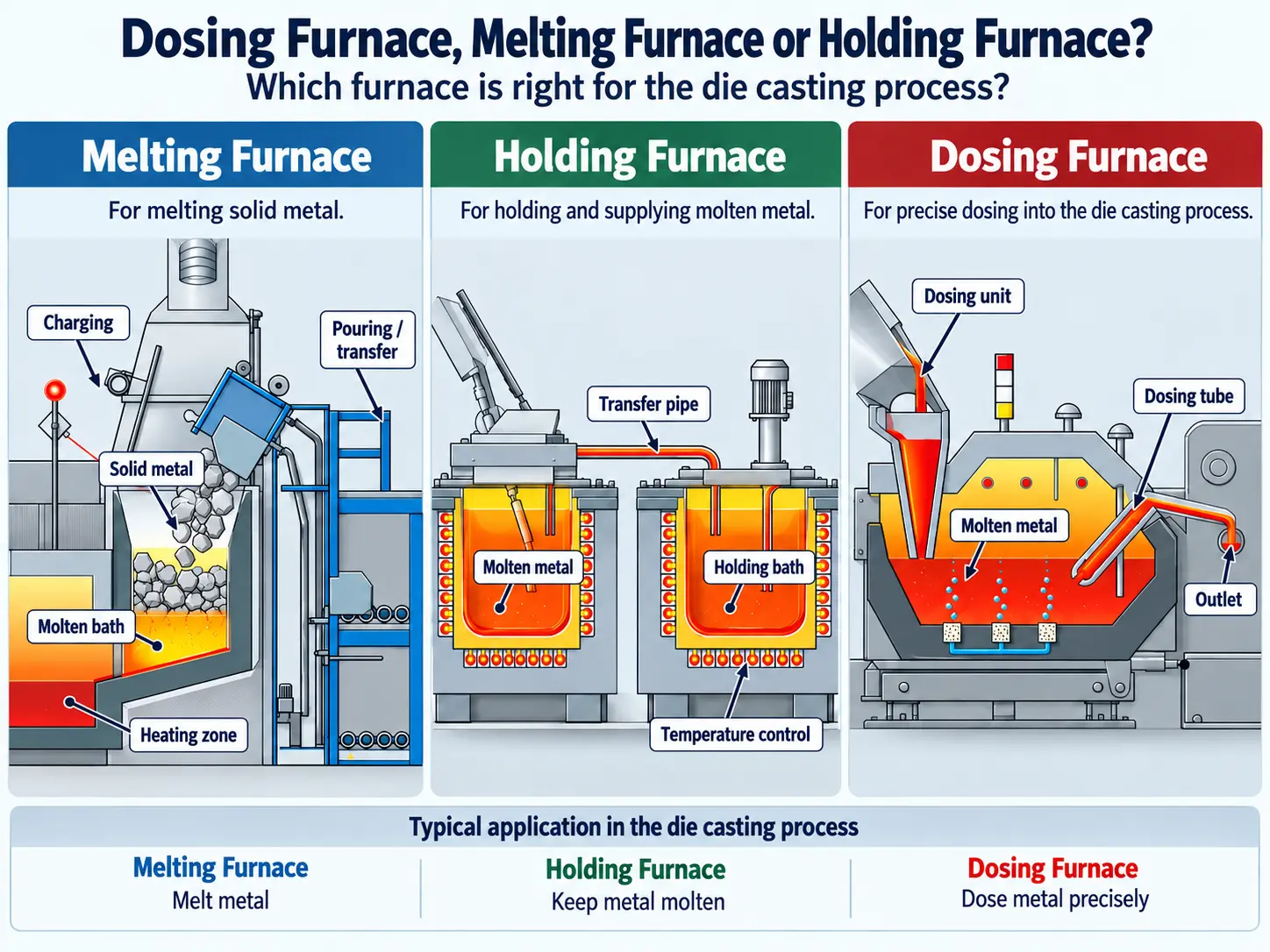
A melting furnace primarily converts solid charge material such as ingots or return material into molten metal. A holding furnace keeps already molten metal available within the required temperature range. A dosing furnace stores molten metal and supplies a defined quantity to the casting process.
In an automated cold chamber die casting cell, these functions can form a process chain: metal is melted, held or conditioned and then dosed into the shot chamber for each casting cycle. Depending on furnace design, some functions can also overlap.
The Right Furnace Depends on Its Function in the Metal Flow
Furnace selection should not begin with temperature or furnace capacity alone. The first question is what the furnace has to do within the production process.
A foundry may need to melt solid metal, buffer molten metal between production steps, maintain stable temperatures, provide a defined shot quantity or combine several of these tasks.
This is why the terms melting furnace, holding furnace and dosing furnace describe primarily the function of the equipment. Depending on the furnace design, a single unit may cover more than one function.

Melting, Holding and Dosing at a Glance
Melting Furnace
The main task is to convert solid charge material into molten metal. Depending on the furnace concept, ingots, clean return material or other suitable charge material can be processed.
Holding Furnace
Holds already molten metal at the required temperature and makes it available to the next production step. It can also serve as a buffer between melting and casting.
Dosing Furnace
Keeps molten metal available and supplies a controlled quantity to the casting machine. Repeatable dosing is particularly important in automated cold chamber production.
From Solid Charge Material to Molten Metal
A melting furnace is designed primarily to provide the thermal energy required to transform solid metal into molten metal. Depending on foundry requirements, different furnace technologies and heating principles can be used.
In aluminium processing, the furnace may receive ingots as well as suitable return material from the casting process. Furnace design, charging method, metal throughput and production concept determine how the melting stage is organized.
Once the required molten metal is available, it can be transferred to a holding furnace, transport ladle, dosing system or another downstream part of the metal supply system.
FISS offers used melting furnaces for foundry and die casting applications.
Keeping Molten Metal Available for the Casting Process
Once the metal has been melted, the next challenge is keeping it available under suitable thermal conditions until it is required by the casting process.
A holding furnace therefore focuses less on melting large quantities of cold charge and more on maintaining the molten metal within a defined process window.
Depending on the production concept, a holding furnace can act as a buffer between a central melting furnace and one or more casting machines. It may also be used to stabilize the metal temperature before further transport or dosing.
Supplying a Defined Quantity of Molten Metal
A dosing furnace combines molten-metal holding with controlled metal delivery. Its task is to provide the casting machine with the required quantity of molten metal for the next cycle.
In aluminium casting systems, dosing can be carried out using pressure-controlled furnace concepts in which molten metal rises through a delivery system and a defined amount is discharged. Control of the dosing process is important for achieving repeatable metal quantities from cycle to cycle.
In cold chamber die casting, a consistent amount of molten metal supports repeatable filling conditions in the shot chamber. The dosing furnace therefore becomes an important part of the automation concept of the complete cell.
Current equipment can be found under used dosing furnaces .
Melting Furnace vs. Holding Furnace vs. Dosing Furnace
| Criterion | Melting Furnace | Holding Furnace | Dosing Furnace |
|---|---|---|---|
| Main function | Melt solid metal and provide molten metal. | Keep molten metal available within the required temperature range. | Hold and deliver a controlled amount of molten metal. |
| Typical position | Beginning of the molten-metal supply process. | Between melting, transport and casting. | Close to or integrated with the casting machine. |
| Primary performance focus | Melting capacity and energy transfer. | Temperature stability and availability of molten metal. | Dosing accuracy, repeatability and cycle integration. |
| Material input | Solid charge material and/or suitable return material. | Molten metal. | Molten metal. |
| Connection to casting cycle | Usually indirect. | Indirect or process-dependent. | Often directly coordinated with the casting cycle. |
| Automation relevance | Charging, level control and central melt supply can be automated. | Temperature and level control are central functions. | High relevance because dosing must be synchronized with the machine. |
How the Furnaces Can Work Together in Cold Chamber Die Casting
Not every foundry uses all three furnace functions as separate machines. Nevertheless, the following process sequence illustrates how the tasks can be divided in a larger aluminium die casting system.
Prepare the Charge
Ingots and suitable return material are prepared according to alloy, melt quality requirements and the production concept.
Melt the Metal
The melting furnace converts the solid charge into molten metal and provides the required melting capacity for production.
Hold and Stabilize the Melt
Molten metal can be transferred to a holding furnace where it remains available for the casting process at the required temperature.
Dose the Required Quantity
The dosing furnace supplies the quantity required for the next casting cycle and transfers it to the machine-side metal supply.
Start the Die Casting Cycle
In a cold chamber machine, the molten metal enters the shot chamber and is then injected into the closed die by the shot system.
Why Temperature Stability Matters
The furnace is not simply a container for hot metal. Metal temperature influences the conditions under which the melt is transported, dosed and cast.
Excessive temperature fluctuations can change the thermal conditions of the casting process from cycle to cycle. At the same time, unnecessarily high holding temperatures can increase energy demand and place additional thermal load on the furnace system and the molten metal.
Furnace capacity, heating system, insulation, control strategy and metal throughput should therefore be matched to the actual production demand rather than selected independently.
Why Dosing Accuracy Is Important in Cold Chamber Die Casting
In cold chamber die casting, the molten metal required for each shot must be transferred into the shot chamber before injection. Variations in this quantity can change the conditions inside the shot chamber and influence the subsequent casting cycle.
A reproducible dosing system therefore contributes to a stable starting condition for each shot. The correct quantity depends on component, runner system, overflow volume, shot chamber and casting process.
Which Furnace Is Right for the Production Process?
Furnace selection begins with the production requirement. The furnace must fit the alloy, required metal quantity, casting process and integration concept.
- required alloy or range of alloys
- melting capacity per hour
- required holding capacity
- shot weight and required dosing quantity
- production volume and cycle time
- cold chamber, hot chamber, gravity or low pressure casting process
- required temperature stability
- dosing accuracy and repeatability
- heating technology and available energy supply
- insulation and thermal losses
- automation level and control interfaces
- available installation space
- metal transfer between furnace and casting machine
- maintenance access and cleaning requirements
- safety and environmental requirements
What Should Be Checked When Buying a Used Furnace?
With a used furnace, the nameplate and nominal capacity are only the beginning of the assessment. The thermal system, refractory lining, controls and — in the case of a dosing furnace — the dosing technology must also be evaluated.
- furnace type and actual function in the previous process
- manufacturer, model and year of manufacture
- nominal capacity and usable metal capacity
- condition of refractory lining and insulation
- condition of burners or electrical heating elements
- temperature sensors and temperature control
- furnace pressure system where applicable
- dosing mechanism and delivery system
- metal-level measurement and sensors
- control system and machine interfaces
- gas, electrical and compressed-air requirements
- maintenance and repair history
- available manuals and electrical drawings
- availability of spare and wear parts
- transport dimensions and installation requirements
- required refurbishment before recommissioning
FISS offers different used furnaces for foundry applications , including melting furnaces and dosing furnaces .
A Used Furnace Must Fit the Existing Die Casting Cell
A furnace can be technically functional and still be unsuitable for a specific production line.
For example, the available heating capacity may not match the required metal throughput, a dosing furnace may not provide the required shot quantity or the existing control system may not communicate with the die casting machine.
The evaluation should therefore include not only the furnace itself but also its integration into metal supply, automation and the complete casting process.
| Area | Question | Why It Matters |
|---|---|---|
| Capacity | Can the furnace supply the required amount of metal throughout the production shift? | Insufficient capacity can restrict the entire casting cell. |
| Temperature | Can the furnace maintain the required process temperature under real production conditions? | Temperature stability influences the consistency of the downstream casting process. |
| Dosing | Does the dosing range match the required shot quantities? | The furnace must cover the real operating range of the machine. |
| Controls | Can the furnace exchange the required signals with the die casting machine or cell control? | Missing interfaces can require electrical or software adaptation. |
| Installation | Do height, footprint, metal outlet and service connections fit the existing layout? | Mechanical integration can determine whether a used furnace can be installed economically. |
Furnace Technology Is Part of the Complete Casting Process
In cold chamber die casting, metal supply directly precedes the actual shot sequence. The furnace system and dosing technology therefore form part of the process chain that also includes shot control, die temperature, spraying, extraction and downstream automation.
If you want to understand how the complete production cell works, see our Knowledge article on automation in the die casting cell .
For the basic distinction between die casting machine concepts, see cold chamber and hot chamber die casting .
First Define the Furnace Function, Then Select the Machine
Melting furnaces, holding furnaces and dosing furnaces fulfil different tasks in the metal supply system. The melting furnace produces molten metal, the holding furnace keeps it available under controlled thermal conditions and the dosing furnace supplies a defined quantity to the casting process.
Depending on the furnace design and production concept, these functions can overlap. The correct selection therefore cannot be made from the furnace name alone.
Alloy, metal throughput, storage capacity, dosing requirements, energy supply, control technology and integration into the complete casting cell should always be considered together.
Questions About Melting, Holding and Dosing Furnaces
What Is the Main Difference Between a Melting Furnace and a Holding Furnace?
A melting furnace is primarily designed to convert solid metal into molten metal. A holding furnace primarily keeps already molten metal within the required temperature range and makes it available to the casting process.
What Does a Dosing Furnace Do?
A dosing furnace holds molten metal and provides a defined quantity to the casting process. In automated cold chamber production, this dosing step is synchronized with the die casting machine.
Can One Furnace Melt and Hold Metal?
Yes. Depending on the furnace design, a furnace can perform both melting and holding functions. The technical function of the unit is therefore more important than the category name alone.
Why Is a Dosing Furnace Important in Aluminium Die Casting?
Cold chamber aluminium die casting requires molten metal to be introduced into the shot chamber for each casting cycle. Repeatable dosing helps provide a consistent starting condition for the shot process.
Is a Holding Furnace Always Required?
No. The required furnace configuration depends on the production system. Some plants separate melting, holding and dosing, while others combine functions in fewer furnace units.
Which Parameters Are Important When Selecting a Furnace?
Important parameters include alloy, melting capacity, holding capacity, shot weight, dosing range, temperature control, energy supply, automation interfaces, installation space and maintenance requirements.
What Should Be Checked on a Used Dosing Furnace?
In addition to lining, insulation and heating system, the dosing mechanism, sensors, temperature control, furnace pressure or drive technology, machine interfaces, maintenance history and spare-parts availability should be checked.
Does FISS Offer Used Furnaces for Die Casting?
FISS offers used furnace systems for foundry applications, including melting furnaces, dosing furnaces, crucible furnaces, induction furnaces, aluminium recycling furnaces and other industrial furnace systems.
FISS Helps Match the Furnace to the Casting Process.
Whether you need a melting furnace, dosing furnace or another used furnace system, the equipment should match the alloy, required metal quantity, production capacity and existing casting cell. FISS can support the search for suitable used furnaces and related foundry equipment.
Source
Bührig-Polaczek, A.; Michaeli, W.; Spur, G. (eds.): Handbuch Urformen, Carl Hanser Verlag, Chapter 1.4 “Technology of Melting and Casting”, especially sections on resistance furnaces and casting/dosing technology.
