


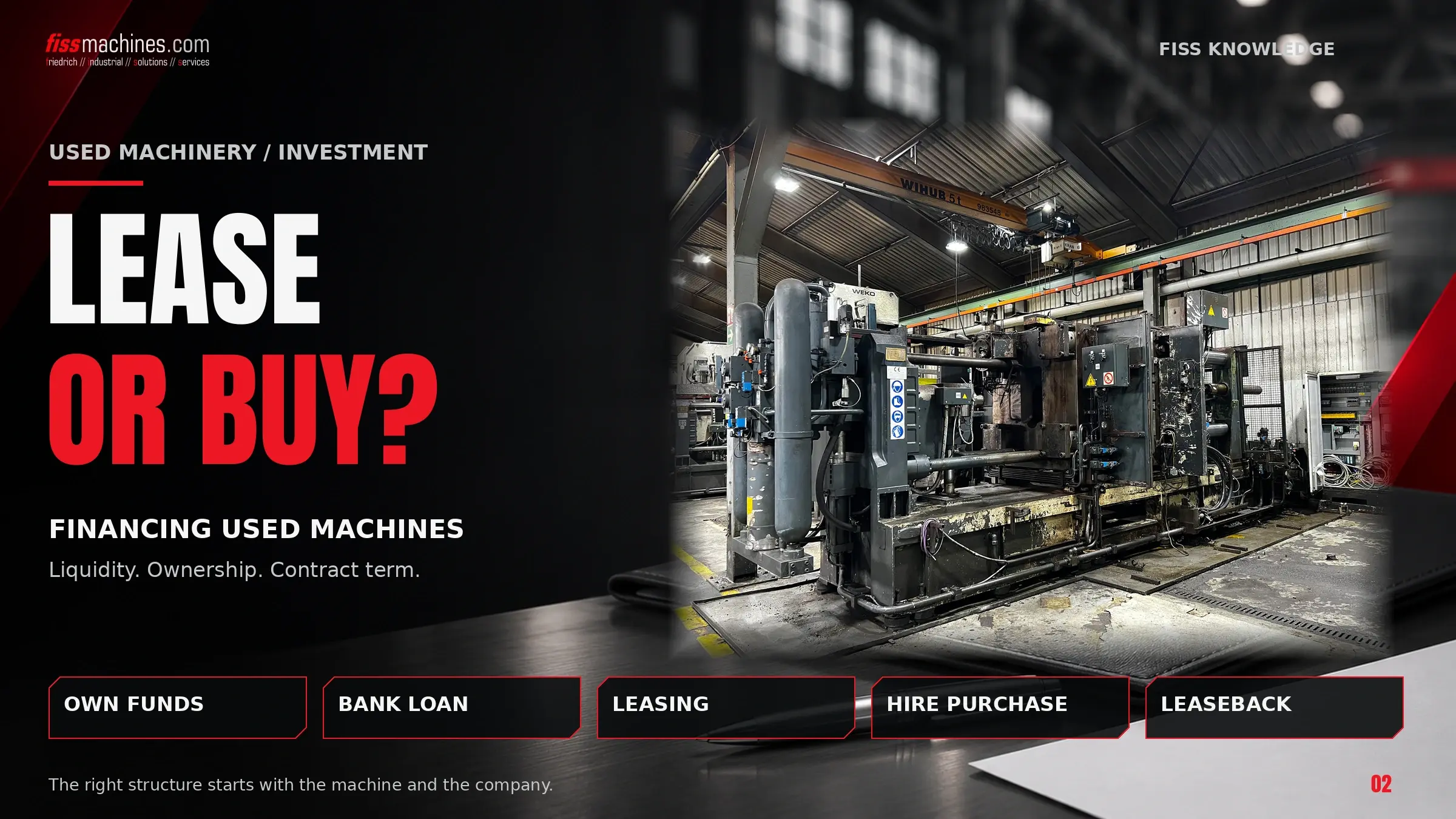
Lease or Buy? Financing Used Foundry and Die Casting Machines
A used die casting machine, trimming press or melting furnace ties up a significant amount of capital. Whether to lease or buy used machinery is therefore not only a question of price, but of liquidity, balance sheet, flexibility and the end of the contract.
Lease or Buy Used Machinery – Which Is Better?
There is no general answer. Buying from own funds or with a bank loan makes the company the owner from day one, but ties up capital or credit lines. Leasing spreads the cost over the term and can preserve liquidity; the machine belongs to the lessor, and the options at the end of the term are agreed in the contract. Hire purchase leads to ownership by instalments, and sale-and-leaseback releases capital tied up in machines already in use.
The right model depends on liquidity, financial reporting, tax situation and planned useful life. This article is general information, not tax, legal or financial advice – have your case reviewed by your tax advisor and financing partner.
Five Ways to Finance a Used Machine
The models differ in ownership, timing of payments and what happens at the end. Simplified overview – details depend on the contract:
| Model | Ownership | Liquidity | End of Term |
|---|---|---|---|
| Own funds | Buyer from the start | Full price paid at once | No contract end – machine is owned |
| Bank loan | Buyer from the start (often with the machine as collateral) | Repayment in instalments, uses credit lines | Loan repaid, collateral released |
| Leasing | Lessor; lessee has the right of use | Lease payments over the term, little or no equity | Return, extension or purchase – as agreed |
| Hire purchase | Transfers to the buyer, usually with the last instalment | Instalments over the term | Machine is owned |
| Sale-and-leaseback | Lessor buys the machine from the user | Releases capital tied up in the machine | As agreed, e.g. repurchase at a defined residual value |
Buying: Own Funds or Bank Loan
Simple and Independent
No financing costs, full freedom to modify, relocate or resell. The price: liquidity no longer available for dies, peripherals or working capital.
Ownership with Instalments
The company owns the machine and repays the loan over time. The bank assesses creditworthiness and collateral; the loan uses credit lines.
With a purchase, the machine appears in the company’s own balance sheet and is depreciated over its useful life. For a used die casting machine, the purchase price is rarely the whole investment: transport, foundations, commissioning and possibly an overhaul must be financed too. Technical checks before buying are covered in Buying a Used Die Casting Machine.
Leasing: Full Payout or Partial Payout
In a finance lease, the lessor buys the machine and leaves it to the lessee for use against regular payments. Maintenance, insurance and the risk of loss usually remain with the lessee. Two basic forms are common in Germany:
Payments Cover the Full Cost
During the basic lease term, the lease payments cover the lessor’s acquisition cost plus financing costs and margin. Payments are higher, but no large residual value remains.
A Residual Value Remains
The payments only cover part of the cost; a residual value is calculated for the end of the term. Depending on the contract, the lessor can require the lessee to buy the machine at that value, or excess proceeds from a sale are shared.
Service components such as maintenance or insurance can be included. The options at the end – return, extension or purchase – are defined by the contract.
Hire Purchase and Sale-and-Leaseback
Hire purchase is closer to a financed purchase than to leasing. In the usual form, the purchase is agreed from the start, legal ownership transfers with the last instalment, and the buyer is generally treated as economic owner from the beginning – the machine is capitalised and depreciated by the buyer. In Germany, value added tax on the full amount may be due at the start, which has to be bridged in liquidity planning.
Sale-and-leaseback works the other way round: a company sells a machine it already owns to a leasing company, receives the purchase price and leases the machine back. The machine stays in production without interruption. Feasibility depends heavily on the value the lessor attributes to the machine.
Liquidity and Balance Sheet: What Changes
The often-quoted off-balance-sheet advantage of leasing does not apply to everyone. Companies reporting under IFRS 16 (effective for reporting periods beginning on or after 1 January 2019) recognise most leases as a right-of-use asset and a lease liability. Exemptions exist for short-term leases of up to 12 months and leases of low-value assets – a die casting machine is not a low-value asset.
For companies reporting under German commercial law (HGB), the attribution of the leased machine to the lessor or lessee generally follows the tax rules. These are based on the decrees of the Federal Ministry of Finance (BMF) for movable assets – for full-payout contracts from 1971, for partial-payout contracts from 1975. Key criteria include the ratio of the basic lease term to the normal useful life and the design of purchase or extension options. Whether a specific contract leads to attribution to the lessor must be assessed individually.
What Lessors Look at for Used Machines
For a used machine, the lessor assesses not only the lessee’s creditworthiness but also the machine itself – it is the collateral. Typical points:
- Age and remaining useful life: Does the term fit the period of economic use still possible?
- Residual value: What will the machine be worth at term end – the basis for partial payout and repurchase prices?
- Marketability: Common machine types and well-known manufacturers are easier to remarket than special machines.
- Valuation: Depending on the amount, an appraisal or an assessment by the lessor’s own experts may be required.
- Condition and documentation: Maintenance history, overhaul reports and CE documentation support the valuation.
A documented overhaul can make a difference here – background in Overhaul or Retrofit?
How a Lease with a Dealer Typically Runs
Select the Machine
The user selects the machine with the dealer and clarifies scope, condition, transport and commissioning.
Request Financing
The user submits the offer and company data; the lessor assesses creditworthiness and machine.
Lessor Buys from the Dealer
After approval, the lessor buys the machine from the dealer – or steps into a purchase contract already concluded by the user.
Delivery and Acceptance
After delivery, the user signs an acceptance confirmation; the lessor then pays the dealer.
Use and End of Term
The user pays the agreed instalments; at the end, the contractually agreed option applies.
FISS cooperates with an experienced German leasing company and can put buyers in contact with a suitable partner, including for international projects. The structure, review and decision are handled by the leasing or financing partner. Details on the FISS leasing page.
Choose the Model That Fits the Machine and the Company
Buying is simplest when liquidity is sufficient and the machine will be used for many years. Leasing and hire purchase spread the burden, sale-and-leaseback releases capital already tied up. For used foundry and die casting machines, the machine’s value is part of the financing decision – condition, documentation and marketability matter as much as the company figures. Clarify the financing framework early and involve your tax advisor. An overview of the machines FISS lists can be found under used die casting machines.
Questions About Financing Used Machines
Can Used Machines Be Leased at All?
Yes. The lessor additionally assesses age, remaining useful life, residual value and marketability, and may require a valuation.
Does Leasing Keep the Machine Off the Balance Sheet?
Not necessarily. Under IFRS 16, lessees recognise most leases. Under HGB and German tax law, attribution depends on the contract design under the BMF leasing decrees – ask your tax advisor.
What Is the Difference Between Leasing and Hire Purchase?
With leasing, the lessor usually remains the owner and the end of term is agreed in the contract. With hire purchase, ownership is intended from the start and the buyer is generally treated as the economic owner.
Does FISS Provide Financing Itself?
No. FISS arranges contact with a leasing partner. The structure, review and decision are handled by the leasing or financing partner.
Finance Used Machines with FISS.
Tell FISS which used machine and investment you have in mind – FISS will put you in contact with a suitable leasing or financing partner.
Sources
FISS Machines: service page Leasing & Financing – Finance and Lease Used Machines, fiss-machines.com, accessed 5 November 2026.
IFRS Foundation: IFRS 16 Leases, issued January 2016, effective for annual reporting periods beginning on or after 1 January 2019, ifrs.org, accessed 5 November 2026.
German Federal Ministry of Finance (BMF): letters on the income tax treatment of leasing contracts for movable assets of 19 April 1971 (BStBl I 1971, p. 264; full payout) and 22 December 1975 (partial payout), as listed in the annex to the German income tax guidelines.
IWW Institut, BBP: Leasing: In drei Schritten zur sicheren Zurechnung des Leasinggegenstands, iww.de, accessed 5 November 2026.
C. Fritzen (NetBid Finance GmbH): Nachhaltige Kreislaufwirtschaft mit gebrauchten Maschinen – Finanzierungsmodelle für eine nachhaltige Nutzung, FLF Finanzierung Leasing Factoring 1/2025.
Deutsche Handwerks Zeitung: S. Hildebrandt-Woeckel, Finanzierung Mietkauf: 10 Fragen und Antworten für Chefs im Handwerk, 2023, accessed 5 November 2026.
