


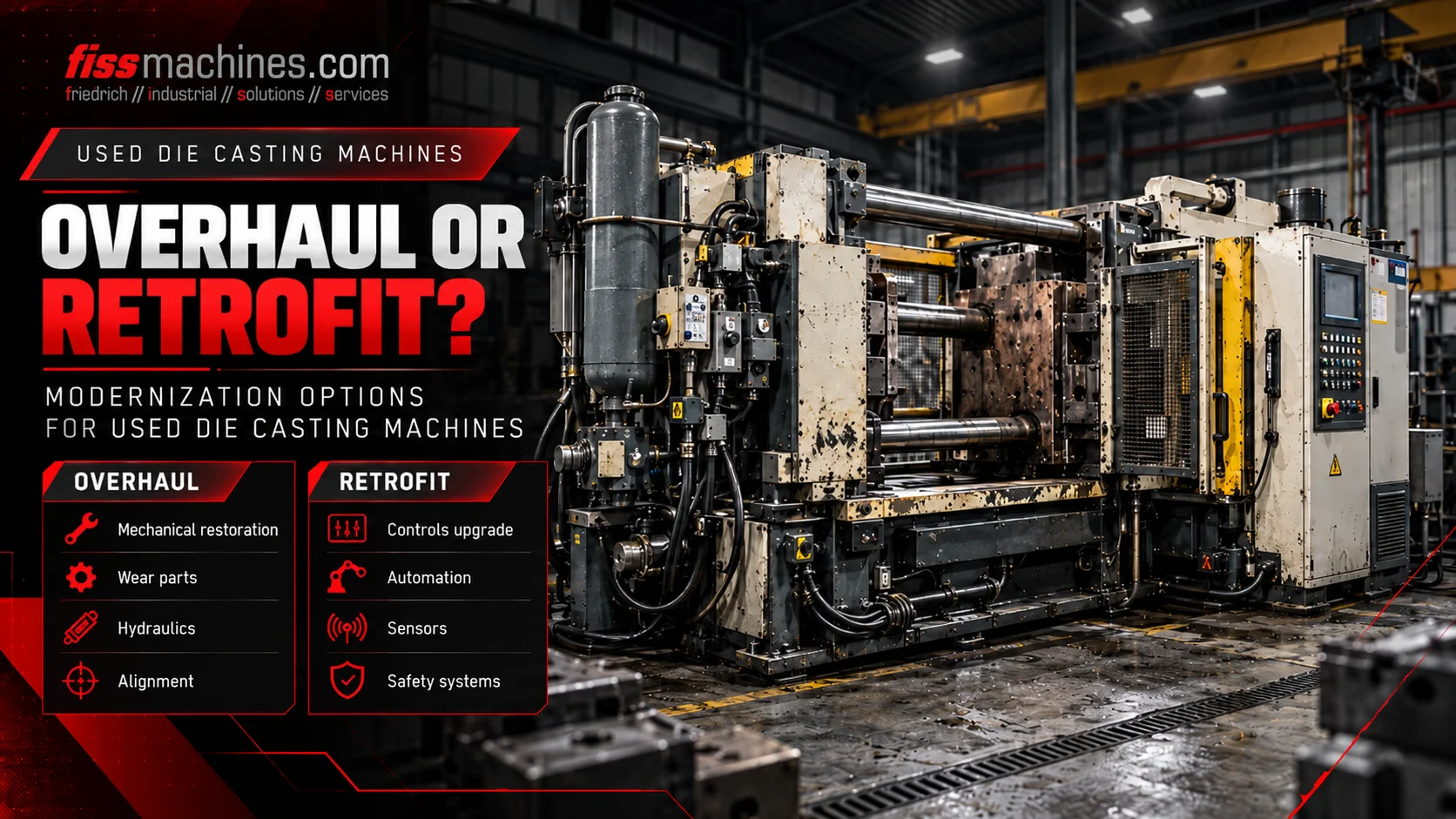
Overhaul or Retrofit? Modernising Used Foundry Machines
A used die casting machine or furnace often has a robust structure that can run for many more years. What limits it is usually something else: worn hydraulics, an obsolete control for which spare parts are hard to find, or a safety concept that no longer matches current expectations. "Overhaul" and "retrofit" are often used as if they meant the same thing. They do not, and confusing them leads to wrong budgets and wrong expectations.
What Is the Difference Between Overhaul and Retrofit?
An overhaul restores the machine's mechanical, hydraulic and electrical condition, largely within its original design: seals, cylinders, pumps, valves, guides and wear parts are inspected, repaired or replaced. A retrofit changes the design, typically by replacing the control, drives, sensors or shot control with current technology.
Both have to be followed by a safety review. Whether a modified machine meets the requirements at its place of use is not automatic; it depends on the scope of the changes and has to be assessed and documented.
What an Overhaul Covers
An overhaul starts with a structured inspection and ends with a function test. In between, the scope can range from replacing a few seals to dismantling the machine completely. Terms such as "partial overhaul" and "full overhaul" are not standardised, so the actual list of work matters more than the label.
Typical scope on a die casting machine
- Hydraulic cylinders resealed, rods and bores checked
- Pumps, valves and filters inspected or replaced, oil changed
- Accumulators inspected according to applicable rules
- Platen parallelism, tie bars and guides measured
- Toggle bushings and pins checked on toggle machines
- Shot cylinder, shot sleeve mounting and coupling inspected
- Cooling, lubrication and electrical wiring checked
An overhaul is the right approach when the structure is sound and the existing control still works reliably and can be supported with spare parts. It preserves the machine's known behaviour and documentation.
When a Retrofit Makes Sense
Controls age faster than steel. A machine may be mechanically fit, but its control can no longer be repaired economically, or it cannot provide the data and interfaces a modern cell expects. A retrofit then replaces selected systems with current components.
New PLC and operator panel with current software and documentation.
Valves, sensors and recording for a more repeatable shot and usable shot curves.
Pump drives or motor control updated where the hydraulic design allows it.
Signals for robots, sprayers, presses and data collection.
Retrofits are projects, not repairs. They need a specification, software engineering, commissioning and new documentation, and they change how operators and maintenance staff work with the machine. How peripheral units connect in a cell is described in our article on automation in the die casting cell.
Safety Revalidation: Not Automatic
Every overhaul and especially every retrofit touches safety-related functions: guards, interlocks, emergency stop, two-hand controls, and the behaviour of hydraulics when energy is removed. After the work, these functions have to be checked and the result documented.
Beyond testing, the scope of a modification can have legal consequences. In the European Union, a modification that was not foreseen by the original manufacturer and that affects safety, by creating a new hazard or increasing an existing risk, may be considered substantial. Whoever carries it out can then take on manufacturer obligations, including risk assessment and conformity documentation. The EU Machinery Regulation (EU) 2023/1230, which applies from January 2027, explicitly addresses such substantial modifications. Whether a specific project is affected has to be assessed case by case; operator obligations under national workplace safety rules apply in any case.
Neither an overhaul nor a retrofit makes a machine compliant by itself. Plan the safety review as part of the project from the start, with qualified people and clear responsibilities between supplier and operator.
Overhaul, Retrofit and Safety Review Compared
| Aspecto | Revisión mecánica | Actualización de control | Revisión de seguridad |
|---|---|---|---|
| Objetivo | Restaurar condición y fiabilidad | Reemplazar sistemas obsoletos, añadir funciones | Confirmar operación segura y documentarla |
| Cambio de diseño | En gran medida ninguno | Sí, en los sistemas modificados | Posiblemente, si se requieren medidas |
| Principales riesgos | Daño oculto encontrado durante el desmantelamiento | Alcance del alcance, software, tiempo de puesta en marcha | Descubrimiento tardío de medidas faltantes |
| Documentación | Inspección e informes de trabajo | Esquemas de circuitos nuevos, software, manuales | Evaluación de riesgos, registros de pruebas |
| Disparador típico | Desgaste, fugas, proceso inestable | Escasez de repuestos, necesidades de datos | Cualquier modificación, reubicación, nuevo sitio |
Cómo Decidir: Cinco Preguntas
¿Es la estructura adecuada?
Grietas en las platinas o marco, guías muy gastadas o barras de unión dañadas pueden hacer que la inversión adicional sea cuestionable.
¿Aún se puede soportar el control?
Verificar disponibilidad de repuestos, copias de software y personal que pueda mantenerlo.
¿Qué requiere el proceso?
Repuestos con altos requisitos de calidad pueden necesitar mejor control de disparo o grabación de datos que la máquina original ofrece.
¿Qué requiere la revisión de seguridad?
Aclarar temprano qué medidas se necesitan en el lugar de uso y quién es responsable de ellas.
¿Cómo se comparan costos y tiempo de inactividad?
Comparar todo el proyecto, incluida la puesta en marcha y la capacitación, con alternativas como una máquina usada diferente.
La inspección de una máquina antes de la compra es un paso separado. Las preguntas anteriores se refieren a lo que ocurre una vez que una máquina está en el lugar o ya en producción, y a qué trabajo realmente necesita.
Preguntas Frecuentes
¿Una máquina overhaulizada funciona como una nueva?
No necesariamente. Una revisión restaura la condición definida en su alcance. Los límites de diseño, las funciones de control y las características de la máquina original permanecen como estaban, a menos que también se cambien.
¿Se pueden combinar overhaul y retrofit?
Sí, y es frecuente. Combinarlos evita desmantelar dos veces, pero el alcance y la revisión de seguridad deben planificarse juntos.
¿Un retrofit es siempre mejor que mantener el control antiguo?
No. Un control funcional y bien documentado con repuestos disponibles puede ser la opción más rentable. Un retrofit compensa cuando la obsolescencia, las necesidades del proceso o la integración lo hacen necesario.
¿Necesita una máquina trasladada una nueva revisión de seguridad?
Una revisión en el nuevo sitio es aconsejable en cualquier caso, porque el entorno, el equipo conectado y las normas aplicables pueden diferir.
FISS Apoya Proyectos de Revisión y Selección de Maquinaria.
Hablar con FISS sobre la condición de su máquina y el alcance que está considerando, o sobre máquinas usadas que podrían someterse a sobrehauling para adaptarse a sus requisitos.
